
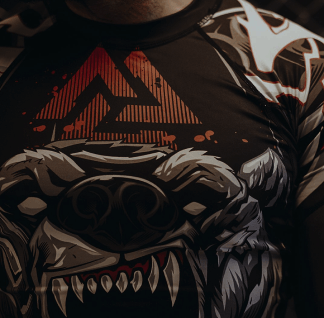
.png)
When you choose sportswear, you usually look at the design, fit, and fabric. But there is one more important factor — the type of print.
On everyday clothing, the print has a calmer life: office, street, a few washes per week. But even there it is unpleasant when the graphic cracks and flakes — your favorite T‑shirt immediately looks tired. In training, the load is completely different: sweat, friction against the mat or a partner, frequent washing. In this environment, a weak print dies much faster.
The printing technology determines whether the fabric will stretch freely, breathe normally, and maintain its appearance under such conditions.
Some prints are almost unnoticeable on the body and stay sharp for a long time. Others quickly crack, create a greenhouse effect, and distract you while you train.
Below we will break down which printing methods are used on sportswear and which one you should look for if you train regularly.
Main types of prints on sportswear
Sports and everyday clothing use several basic printing technologies. Each has its own tasks and features. The table below shows the main printing methods and what they offer.
| Printing method | Most common use | What it gives |
| Sublimation | Rashguards, compression wear, polyester uniforms | Lightweight print, almost not felt on the fabric, highly resistant to washing |
| Screen printing | T‑shirts, hoodies, cotton merch | Thick, bright ink layer, well suited for large runs |
| Heat transfer / vinyl | Numbers, names, small logos | Convenient way to personalize uniforms |
| DTG / DTF | Small batches of T‑shirts, complex illustrations | Allows detailed multi‑colour prints |
The difference between these technologies becomes especially noticeable when it is not about a city walk, but about training.
What sublimated graphics are
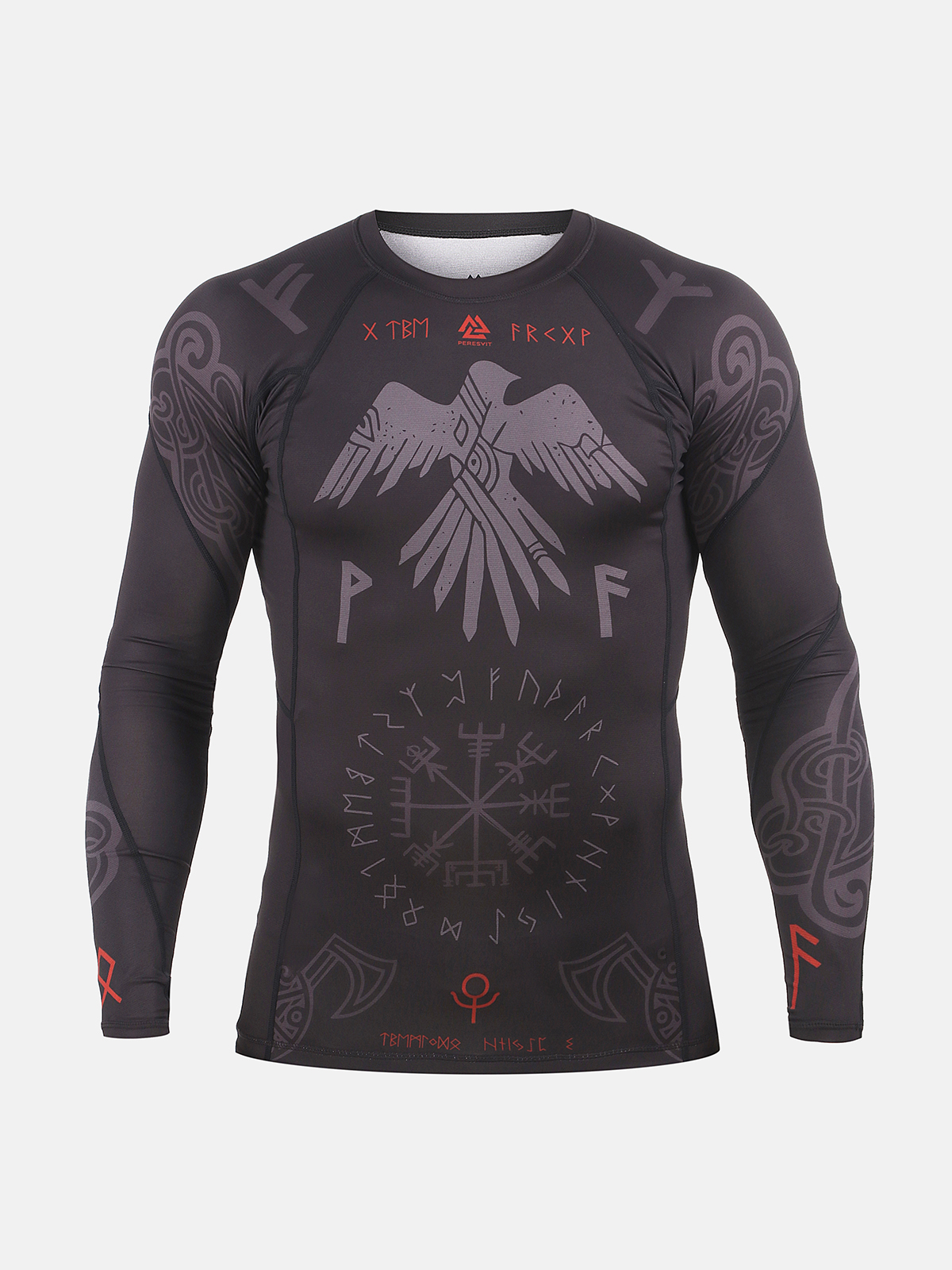
With sublimation, the ink does not sit as a separate layer on the fabric surface. Under heat and pressure it turns into gas and embeds directly into the structure of the material. As a result, the print becomes part of the fabric.
It does not form a stiff layer, does not crack on folds, and does not peel off over time. The material remains just as soft, elastic, and breathable as without the graphic. However, sublimation printing is only possible on synthetic materials. Cotton and sublimation simply do not go together.
This is especially important if you train regularly. A rashguard or compression shorts are constantly stretching, twisting, and rubbing against the mat or a partner’s gear. In such conditions a low‑quality print starts to show its limitations very quickly.
Sublimated graphics behave differently. The fabric stretches evenly across the entire surface, and the design stretches together with the material. That is why this technology is most often used for rashguards, compression clothing, leggings, and polyester training uniforms — like in the Valhalla rashguards.
Sublimation and screen printing: how it feels in training
Screen printing works simply: the ink passes through a stencil and remains as a dense layer on the surface of the fabric. For everyday clothing this is a good option. On a T‑shirt or hoodie such a print almost does not interfere and creates a familiar texture of the image — like on the Flying Judo Hoodie Navy Blue.
But on sports gear the difference becomes more noticeable.
The thick ink layer stretches worse, partially blocks the fabric structure, and retains more heat. Over time, with frequent stretching and washing, cracks may appear on such prints.
Sublimation works differently. Because the ink becomes part of the fabric, the material stretches evenly over the entire surface. You do not feel a border between areas with and without graphics, and the fabric maintains its breathability.
Even if the design covers the entire surface of the garment, the rashguard remains elastic and comfortable in motion.
To make it easier to compare the options specifically from a training perspective, you can present the difference like this.
| Printing method | Comfort on the body | Behavior under regular training | When to choose |
| Sublimation | Print is almost not felt | Does not crack or peel, preserves fabric elasticity | Rashguards, shorts, leggings, training uniforms |
| Screen printing | Ink layer is noticeable on the fabric | Holds up well but handles heavy stretching worse | T‑shirts, hoodies, everyday clothing |
| Heat transfer vinyl | Denser area on the fabric | Over time possible cracks and peeling | Numbers, names, uniform personalization |
| DTG / DTF | May feel like an additional layer | Better suited for less intensive use | Casual T‑shirts and merch |
Heat transfer, DTG, and uniform personalization
Heat transfer and vinyl work on a different principle. First the image is printed or cut, and then it is pressed onto the fabric using a heat press.
This method is convenient when you need to add a number, name, or a small logo to an already finished uniform. The team receives matching gear, and each athlete gets their own personalization.
But this solution has its limitations.
The vinyl remains a separate element on the surface of the fabric. In these areas the material stretches worse and passes less air. With intense training and frequent washing, the edges of such a print may start to crack or lift.
DTG, DTF, and similar technologies make it possible to print complex illustrations in small runs. They are well suited for casual clothing and merch, where the main focus is on appearance.
For gear that works regularly in the gym, these methods are used less often — by feel it is still an additional layer on the fabric.
How print type affects comfort and durability
During training three things are especially important: how the fabric breathes, how freely it stretches, and how long the garment stays in working condition.
If the print creates a dense layer on the surface of the fabric, the material starts to wick moisture worse and let less air through.
Sublimation does not close the pores in the fabric — the gear continues to handle moisture properly and stays breathable.
The situation with elasticity is similar. A stiff print creates an area that stretches worse.
A sublimated graphic stretches together with the fabric, so there is simply no difference.
In training such details are felt more strongly than it seems at first glance. When the gear is made properly, you just stop thinking about it — it does not interfere, does not distract, and does not restrict movement.
How to choose a print for your needs
If you start from real use, the choice usually looks like this.
For regular training, sparring, grappling, MMA, and other contact disciplines, items with sublimated graphics work best. Such a print does not restrict movement, does not chafe, and calmly withstands a large number of washes.
For everyday clothing and merch, cotton with screen printing or modern fabric printing methods is used more often. The loads are lower here, so the appearance and texture of the print are more important.
For personalizing finished products, heat transfer is the most convenient. Numbers, names, and logos can be added after the uniform is sewn.
Why we use sublimated graphics
We make gear for those who spend a lot of time in the gym, on the mat, or in the ring.
In this mode, weak solutions show themselves quite quickly. The print starts to crack, break at the folds, or prevent the fabric from working properly.
Sublimation provides a more reliable result. The print becomes part of the material, does not form stiff areas, and does not prevent the fabric from stretching and breathing.
That is why Peresvit rashguards, shorts, leggings, and other training apparel rely on this technology. The design stays expressive, but the gear keeps doing the main thing — working with you calmly during training. With no extra noise and no failures.